Abstract
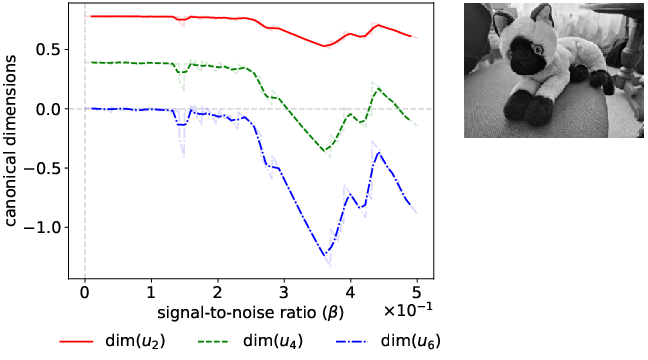
Signal detection is one of the main challenges of data science. According to the nature of the data, the presence of noise may corrupt measurements and hinder the discovery of significant patterns. A wide range of techniques aiming at extracting the relevant degrees of freedom from data has been thus developed over the years. However, signal detection in almost continuous spectra, when the signal-to-noise ratio is small, remains a known difficult issue. This paper develops over recent advancements proposing to tackle this issue by analysing the properties of the underlying effective field theory arising as a kind of maximal entropy distribution in the vicinity of universal random matrix distributions. Nearly continuous spectra provide an intrinsic and non-conventional scaling law for field and couplings, the scaling dimensions depending on the energy scale. The related coarse-graining over small eigenvalues of the empirical spectrum defines a specific renormalisation group, whose characteristics change when the collective behaviour of “informational” modes become significant, that is, stronger than the intrinsic fluctuations of noise. This paper pursues three different goals. First, we propose to quantify the real effects of fluctuations relative to what can be called “signal”, while improving the robustness of the results obtained in our previous work. Second, we show that quantitative changes in the presence of a signal result in a counterintuitive modification of the distribution of eigenvectors. Finally, we propose a method for estimating the number of noise components and define a limit of detection in a general nearly continuous spectrum using the renormalisation group. The main statements of this paper are essentially numeric, and their reproducibility can be checked using the associated code.
Installation
The framework has been developed under _Python_ 3.12.7. It is recommended to use uv for package management.
Production Version
You can directly install the package using uv:
uv tool install git+https://github.com/thesfinox/frg-signal-detection.git
Development Version
To develop the package, you can clone the repository and sync the environment:
git clone https://github.com/thesfinox/frg-signal-detection.git
cd frg-signal-detection
uv sync
To install the dependencies for documentation or testing, you can use the optional groups:
uv sync --group docs
uv sync --group tests
Usage
If you installed the package in production mode, you first need to initialize the workspace:
frg-init
This will copy the default configuration files and scripts to your current directory. You can then run the various tools using their CLI entry points.
The package relies on the definition of configuration files based on the yacs system, following this template:
DATA:
   OUTPUT_DIR: results
DIST:
   NUM_SAMPLES: 1000
   RATIO: 0.5
   SEED: 42
   VAR: 1.0
   IS_POIS: false
   POIS_DATA: false
   POIS_LAM: 10.0
   POIS_MODE: centered
POT:
   KAPPA_INIT: 1.0e-05
   U2_INIT: 1.0e-05
   U4_INIT: 1.0e-05
   U6_INIT: 1.0e-05
   UV_SCALE: 1.0e-05
SIG:
   INPUT: null
   SNR: 0.0
Allowed entries are:
DATA.OUTPUT_DIR: directory where the results will be stored,DIST.NUM_SAMPLES: size of the data sample to use,DIST.RATIO: ratio between the number of variables (degrees of freedom, or columns of the data matrix) and the sample size (rows of the data matrix),DIST.SEED: random seed to use,DIST.VAR: variance of the distribution (previouslySIGMA),DIST.IS_POIS: boolean flag to enable Poisson noise injection,DIST.POIS_DATA: ifTrue, Poisson noise is added directly to the data (overwriting the Gaussian component). IfFalse, it is added to the covariance matrix,DIST.POIS_LAM: lambda parameter for the Poisson distribution,DIST.POIS_MODE: centering mode for Poisson noise (centered,non-centered, ormirrored),POT.KAPPA_INIT: initial value for the location of the zero of the potential,POT.U2_INIT: initial value for the mass (quadratic) coupling,POT.U4_INIT: initial value for the quartic coupling,POT.U6_INIT: initial value for the sextic coupling,POT.UV_SCALE: UV high energy scale,SIG.INPUT: path to the input signal or covariance matrix,SIG.SNR: signal-to-noise ratio (the signal will be scaled by this factor). SettingSNR < 0discards noise.
Noise Injection Use Cases
The framework supports four primary noise modelling scenarios controlled via configuration:
Signal + Gaussian Noise: Set
DIST.IS_POIS: falseandSIG.SNR >= 0. Noise is added directly to the data.Signal + Poisson Noise: Set
DIST.IS_POIS: true,DIST.POIS_DATA: true, andSIG.SNR >= 0. Poisson noise completely overwrites the Gaussian background.Mixed Noise (Gaussian + Poisson): Set
DIST.IS_POIS: true,DIST.POIS_DATA: false, andSIG.SNR >= 0. Gaussian noise is added to the signal, while Poisson noise is injected into the covariance matrix.Pure Signal: Set
SIG.SNR < -1.0(or any negative value) to discard the noise component entirely.
Generation of Multiple Configuration Files
Starting from a base configuration file, multiple derived configurations can be automatically generated using the frg-generate-config command:
frg-generate-config \
   --config /path/to/base_config.yaml \
   --params /path/to/parameters.json \
   --n_samples <number_of_files_to_generate> \
   --output_dir /path/to/output_directory \
   --seed <random_seed>
New points are generated using random sampling of the parameter space, using a Latin Hypercube Sampling (LHS) algorithm.
The JSON file containing the parameters to sample must be formatted using the configuration keys as keys (case-insensitive) of the dictionary. Values can then be input as lists containing the minimum value and maximum value. For instance:
{
   "pot": {
      "u2_init": [-1e-05, 1e-05],
      "u4_init": [-1e-05, 1e-05],
      "u6_init": [-1e-05, 1e-05]
   }
}
will act on the parameters POT.U2_INIT, POT.U4_INIT and POT.U6_INIT in the configuration files.
Note
You can use the option --plots to visualise the sampled points in the parameter space.
Computation of the Canonical Dimensions
The command frg-canonical-dimensions can be used to compute the canonical dimensions of the distribution of singular values:
frg-canonical-dimensions \
   --config /path/to/config.yaml
Note
The --analytic argument can be used to run an analytic simulation instead of a numerical one.
Computation of the FRG Equations
The command frg-equations can be used to compute the functional renormalization group equations:
frg-equations \
   --config /path/to/config.yaml
Note
The --analytic argument can be used to run an analytic simulation instead of a numerical one.
Computation of the FRG Equations in Non-trivial Vacuum
The command frg-equations-lpa can be used to compute the functional renormalization group equations in the Local Potential Approximation (LPA) with an expansion around a non trivial vacuum:
frg-equations-lpa \
   --config /path/to/config.yaml
Note
The --analytic argument can be used to run an analytic simulation instead of a numerical one.
Analysis of the Eigenvector Components
The command frg-evc-distribution computes the distribution of the eigenvectors of the correlations:
frg-evc-distribution \
   --config /path/to/config.yaml